
COVID-19
Pathology
😲‼️🦠 This paper from USA (2026-08-05) reports that many people hospitalized with COVID-19 have evidence normally dormant viruses reactivated, particularly cytomegalovirus (CMV), Epstein-Barr Virus (EBV), Human Herpesvirus 6, herpes simplex 1 and 2 (cold sores and genital herpes), and anelloviruses (which 90% of people catch but which normally has no symptoms).
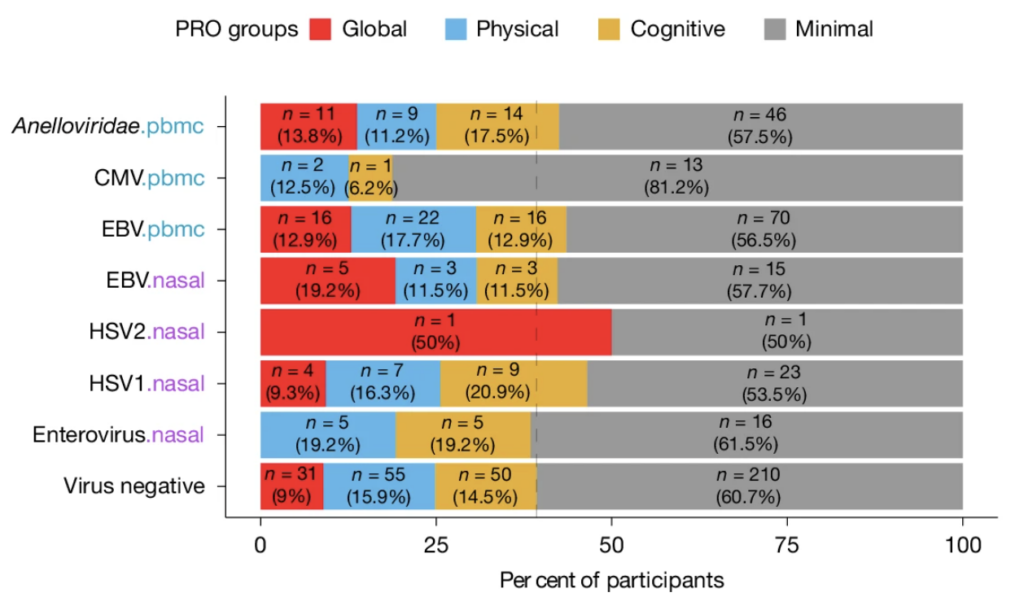
They also found that people who had evidence of reactivation had more severe disease while in hospital. For example, those with severe hospitalization (stays longer than 28 days) with CMV in any respiratory area were more likely to die within 1 year than the severe-hospitalization-patients who did not.
They looked at viral reactivation and Long COVID, but their sample size was too small to declare significance — in part because a lot of their population died!
They did, however, find a correlation between having evidence of anelloviruses while the patients were in hospital and getting Long COVID later.
Long COVID
😲🛌 This paper from Spain (2026-08-04) reports that people who have messed up sleep have higher risks of getting Long COVID as follows:
- People who worked night shift: +88% higher risk than day-shift workers;
- People (night and day shift) who had chronic insomnia:+ 42% higher risk than those who did not;
- People who worked night shift and had chronic insomnia had a 170% higher risk!
🧠 That’s particularly insteresting to me because this paper from Australia (2026-06-22) reports that people with ME/CFS had impaired glymphatic systems (the garbage collection system in their brains). I wonder if the causality that the Australian paper found was backwards: that the poor cerebral garbage collection increased their risk of ME/CFS! (Disclaimer: this forum really disses this paper.)
Variants
🧬 This preprint from China (2026-07-24) reports that variants with a D420N mutation (PQ.16.1.1 and RK.1) are dominating in Asia. They report that those variants don’t bind as well to the ACE2 receptor. I’m not sure (reminder: I’m not a biologist or doctor!) but that might mean that SARS-CoV-2 might be more limited in which cells it can enter. (The ACE2 receptor is on almost all cells.)
However, the researchers also found that the D420N variants were much better at evading antibodies specific COVID Classic than other variants; however, they were worse at evading antibodies specific to Omicron. (Reminder: your immune system has a bias towards antibodies which you made after your first inoculation event (vaccination or infection).
I think (reminder: I’m not a doctor nor biologist!) this means that if you only got the first round of vaccines and haven’t gotten sick with Omicron, you will be more susceptible. If you’ve had an Omicron inoculation event, then I think you will be better off than if you hadn’t, but not as well off as someone whose first inoculation event was with Omicron.
Sorry that I’m a bit hand-wavy about how bad your specific immunity profile will work against the D420N variants, but the research on how strongly your first exposure impedes your response to later variants is kind of thin on the ground plus is constantly going out of date as new variants appear.
Influenza
Vaccines
💉 This article (2026-08-05) reports that the US FDA approved Moderna’s mRNA influenza vaccine for people over 50. That makes it slightly more likely that Canada will approve it as well.
As a reminder, this paper (2026-05-08) reports that Moderna’s mRNA vax was 26.6% more effective than the standard (low-does) shot. There’s a chance that it will be even more advantageous in practice, given that old-style influenza vaccines took long enough to produce that they sometimes were tuned to a strain that didn’t end up being the dominant one.
Measles
Transmission
According to the Government of Canada Measles and Rubella Monitoring Report (updated 2026-07-27), in the week ending 18 July 2026, the following jurisdictions had the following number of new measles cases:
- Canada: 2;
- BC: 2.