
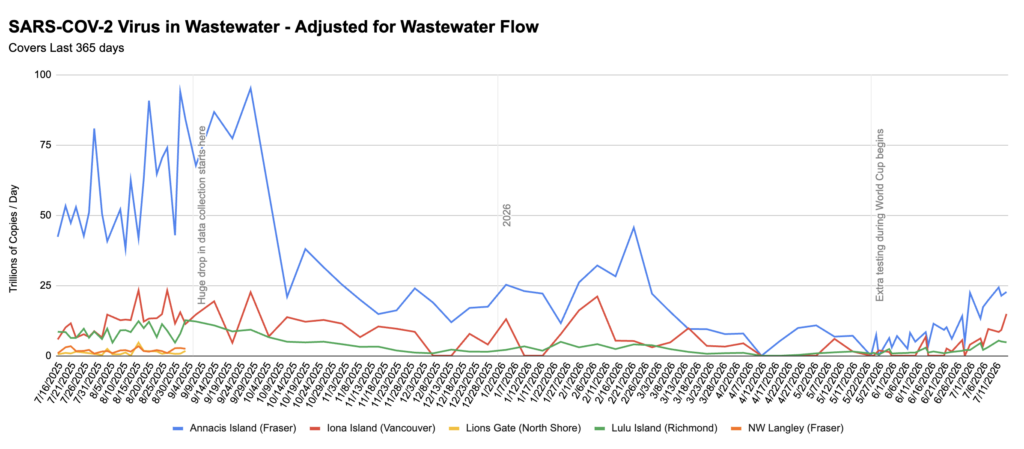
Levels are still slowly going up locally and at many places around the world.
Multiple Pathogens
Recommended Reading
This article (2026-07-20) discusses why people get hostile towards not just the messaging of an epidemic, but also at health care workers.
COVID-19
Long COVID
🧠 This paper from USA (2026-07-21) reports that among people with neurological Long COVID, women have it worse than men. Which symptoms they had more than men varied a little bit depending on whether they were hospitalized or not, but both hospitalized and non-hospitalized female cohorts had it worse than their corresponding male cohort.
This paper using data from 16 countries (2026-05-31) reports that people with Long COVID have a 73% higher chance of developing symptoms very much like the very early (prodromal) stages of Parkinson’s disease. Having dream-enactment behaviours (basically, moving during your dreams) increases the risk by another 38%.
Pathology
🩸 This paper from USA (2026-07-22) reports that women without HIV were more likely to have disruptions to their menstruation if they had a positive COVID-19 test. There was no elevated risk associated with vaccination, body mass index, race, or ethnicity. Interestingly, women with HIV infections did not have any higher risk of menstrual disruptions if they had a positive COVID-19 test.
Vaccines
AGAIN 💉 This unedited manuscript using data 30 million people from all over the world (2026-07-20) found that getting vaccinated is a lot less dangerous than getting a COVID-19 infection.
BC Wastewater
Wastewater levels are still moving slowly upwards.
💩💧 From Jeff’s wastewater spreadsheet, with data through 2026-07-15:
RSV / Pneumonia
Immunization
This paper from France (2026-07-21) reports that babies who were given nirsevimab (a monoclonal antibody) against RSV had about a one-third lower risk of invasive pneumococcal diseases (IPDs) than babies who did not get any RSV prophylaxis. They think that a bout of RSV makes babies at higher risk for pneumonia, but don’t know why.
Note that they did not look at any other preventative treatment for RSV. If the reason that the babies who got nirsevimab had less pneumococcal disease is because they didn’t get RSV (as opposed to something like “the specific antibodies in nirsevimab cross-reacted to pneumonia viruses”), then any RSV prophylaxis should do the same.
In Canada, there are two other monoclonal antibodies approved for RSV prophylaxis (clesrovimab/SYNAGIS and palivizumab/ENFLONSIA), as well as a vaccine for pregnant mothers (RSVpreF / ABRYSVO).
Measles
Transmission
According to the Government of Canada Measles and Rubella Monitoring Report (updated 2026-07-20), in the week ending 11 July 2026, the following jurisdictions had the following number of new measles cases:
- Canada: 5;
- Manitoba: 3;
- BC: 1;
- New Brunswick: 1.
Bundibugyo
Vaccines
There has been some very preliminary research which says that an existing anti-Ebola vaccine offers some protection against Bundibugyo. It doesn’t give as much protection as it does against Ebola, but it’s better than nothing.
This article (2026-07-22) says that WHO and UNICEF have half a million doses stockpiled, but that they were concerned that the data wasn’t good enough to justify drawing down the supply.
The research:
- This comment (2026-07-20) hasn’t been peer reviewed, and the data is only slightly better than anecdotal, but it is encouraging.
- 9 of 1000 people who caught Bundibugyo virus (BDBV) had already been vaccinated against Ebola; none of them died;
- of the 242 people who died from BDBV, none of them had been vaccinated;
- among eight healthcare workers who are believed to have been infected with BDBV by the same person at the same time, the three who had been vaccinated against Ebola lived while all of the other five died.
- This Letter to the Editor using data from West Africa (2026-07-22) reports that people who’d been vaccinated against Ebola had higher the neutralizing antibody levels than in controls, but quite a bit lower than antibodies against Ebola.
- This preprint using data from DR Congo (2026-06-25) reports that the blood of random people from two different provinces had quite varying levels of seroreactivity. In the first province, the seroreactivity level was a lot weaker than the other province, but between 2.5 and 3.5 years, the seroreactivity to BDBV jumped up significantly to almost the same level as the second province.