
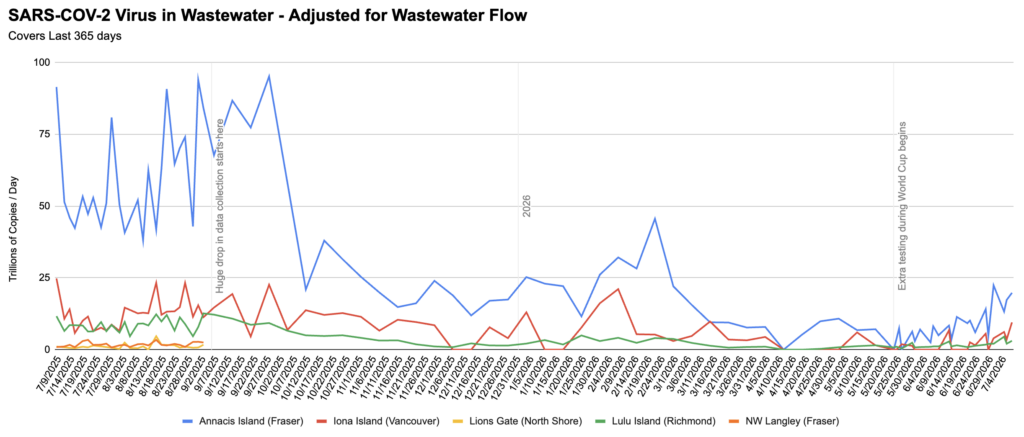
COVID-19 infections are increasing in many places, including — it looks pretty clear now from the wastewater levels — in BC.
The absolute rates are low, but disease spread is always exponential — which means that it can appear that the levels can switch from low to high very quickly. Based on the province’s modelling page, Vancouver’s reproductive rate R was 1.36 on 29 June. (Over 1 means increasing; under 1 means decreasing.)
As I mentioned last week, I believe that you only have until 31 July to get a COVID-19 shot in BC before the fall vaccination campaign starts.
COVID-19
Long COVID
💊 This paper from Norway (2026-07-16) reports that people with a confirmed case of COVID-19 who got Paxlovid had a 40% lower risk of getting Long COVID than those who got a placebo.
COVID-Related Excess Death and Sickness
💰 This paper from USA (2026-07-11) reports that the healthcare utilization cost for people who had a documented COVID-19 infection was higher in the subsequent year than it was for matched controls, for both pediatric and adult patients.
| Age | Acute Severity | Cost for controls | Cost for COVID-19 patients |
| adult | all | $9,040 | $11,508 (+27%) |
| pediatric | all | $2,812 | $3,997 (+42%) |
| adult | outpatient | $8,617 | $10,372 (+20%) |
| adult | hospitalized | $16,926 | $36,848 (+118%) |
| adult | ICU | $17,620 | $51,643 (+193%) |
Transmission
🎂 This paper from Denmark (2026-07-13) reports that grandparents had a greater risk of catching COVID-19 near their grandchildren’s birthday than at other times.
For pre-school children, there was a +17% greater risk of getting a COVID-19 infection between two and eight days after the grandchild’s birthday compared to other times of the year. For school-aged children, the risk was lower: only +7% near birthdays than other times of year.
BC Wastewater
It’s pretty clear now that wastewater levels of COVID-19 are going up.
💩💧 From Jeff’s wastewater spreadsheet, with data through 2026-07-08:
Influenza
Pathology
📆 This paper from USA (2026-07-09) reports that, while severe influenza symptoms usually drop off after about a week, it’s common for mild symptoms to persist for four weeks or more. (Editor: Can confirm. It took me around six weeks to get over the influenza I caught (outdoors!) right before Christmas.)
Vaccines
💊💉 This paper from USA (2026-07-10) reports that taking a painkiller before getting an influenza shot made zero difference in how effective the vaccine was. They looked both at what the neutralizing antibody titres of the blood and whether the patient got sick in took-painkiller and didn’t-take-painkiller cohorts.
Measles
Transmission
According to the Government of Canada Measles and Rubella Monitoring Report (updated 2026-07-14), in the week ending 4 July 2026, the following jurisdictions had the following number of new measles cases:
- Canada: 14;
- Quebec: 7;
- BC: 5;
- Manitoba: 1;
- Ontario: 1.
Recommended Reading
This article from USA (2026-07-16) talks about all the bad things measles can do to you even after the acute phase:
- Erase 11% to 73% of the immunity your body had already learned;
- about 8% to 20% of unvaccinated people who get measles have bad enough cases that they have to go into hospital;
- about 12% of kids with measles develop upper airway swelling that’s bad enough to obstruct their breathing;
- about .1% of kids with measles develop acute encephalitis, which can leave them deaf or with learning disabilities;
- about .16% of kids with measles get “long measles” (Ed: my term, not theirs) — subacute sclerosing panencephalitis — which destroys the brain and is usually fatal.