
COVID-19
Long COVID
‼️‼️ This paper from USA (2026-05-28) reports evidence that Long COVID — at least with with neurocognitive symptoms — is an autoimmune disease. They first used flourescently-tagged antibodies to find ones that looked like they were attacking the self. Next, they tested they extracted these autoantibodies and tested them against human cell tissues from lots of different organs; the organs reacted. Finally, they extracted these autoantibodies from Long COVID patients and injected them into mice; the mice developed with neurocognitive symptoms.
This means that maybe you can treat Long COVID with immunosuppressants! (That’s not ideal — immunosuppressants are bad in a different way — but maybe that’s a tradeoff worth making.)
This paper from Netherlands (2026-04-21) wasn’t as thorough, but it also found that taking IgG from Long Covid patients and injecting them into mice made the mice act kind of like they had Long COVID. (I have a memory of a much older paper which also found the same thing, but maybe I’m remembering an old preprint of this paper.)
This paper from USA (2026-05-22) reports that comorbidities increase the risk of getting Long COVID of about 50%, but that it doesn’t matter if the comorbidities are physical or mental. This is yet another argument that Long COVID is not strictly a psychological illness.
Politics
This paper from USA (2026-05-19) reports that conservatives now die noticeably more than liberals in the US. Conservatives and liberals used to die at about the same rate, but starting a bit before the pandemic, they started to diverge. The paper’s authors put conservatives increased mortality down to a lack of trust in the medical system, which translates to not seeking as much healthcare and/or not as quickly and/or not complying with doctors’ recommendations.
The data about political leaning was survey-based. In the graph below, the different colours correspond to different “waves” of the survey, not different COVID-19 waves. The y-axis shows the difference between the outcome for conservatives and liberals, with a higher score for “this happens more to conservatives than to liberals”:
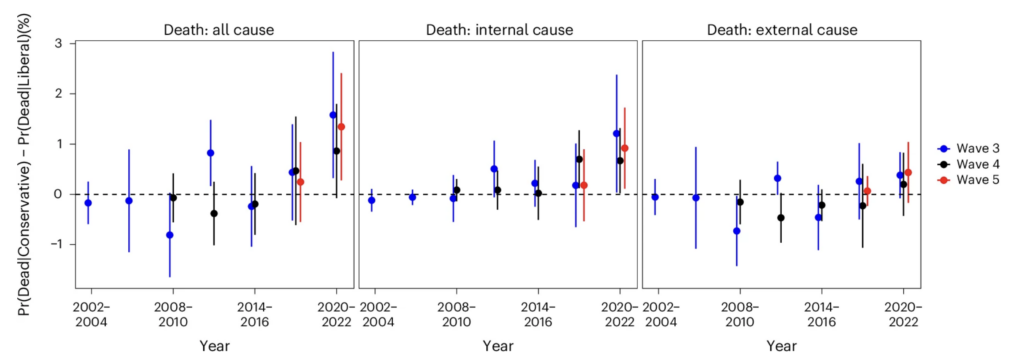
“External cause” deaths are deaths by something large that happens to the person — car accidents, murders, etc. Internal cause deaths are because of a breakdown in your body’s internal function, things like heart attacks, pneumonia, stroke, etc.
It is true that this is USA data and not Canadian data, but we in Canada also have a significant number of people in Canada who have lost trust in the medical system.
Variants
This paper (2026-04-25) suggests that we might not see a lot of change in COVID-19 variants in the future. The researchers created yeast which would express the part of the SARS-CoV-2 spike protein that docks with human receptors (the “receptor binding domain”, RBD), and made it so it would mutate quickly. They then did a lot of mutate/select rounds, killing off the “losers” in a test of how well they docked with human receptors and letting “winners” advance to the next round. They found that if they killed off the vast majority of the losers, the “winners” turned into very Omicron-looking variants quite quickly — and then didn’t change much. Once the winners started looking like Omicron, they didn’t change much.
This is very encouraging! It means we are less likely to get clobbered by some new variant than I had thought. Maybe this is why COVID-19 cases are low kind of everywhere right now: Omicron maybe just isn’t mutating enough to get past our acquired defences? (That would suggest that the main reason why vaccination effectiveness waned over time is because the virus mutated over time.)
Caveats:
- They only tested for how well the RBD docked with human receptors; they did not test for how immune-evasive the RBD was or how stable the RBD was.
- Omnicron might only be at a local fitness maximum, not a global fitness maximum. It might be that if there are a lot of simultaneous mutations (which is unlikely but possible), that could make the RBD even more infectious.
- When they let more of the losers survive into the next round, many variants survived, with Omicron showing up but not taking completely over.
Remember how a while back, I reported that children appeared to be more susceptible to BA.3.2 — which is quite different from other currently-circulating strains — than to other variants? This paper from USA (2026-06-03) reports that children’s antibodies have lower effectiveness against BA.3.2 than adult’s antibodies, even though they have similar effectiveness against NB.1.8.1 and XFG. The authors suggest that this might be because of exposure history — that adults have been exposed to pre-Omicron variants while the three-year-olds they used in the study did not.
(NB: This older study (2025-03-25) found evidence of immune imprinting with SARS-CoV-2, so this seems to me like a plausible hypothesis.)
Influenza
Vaccines
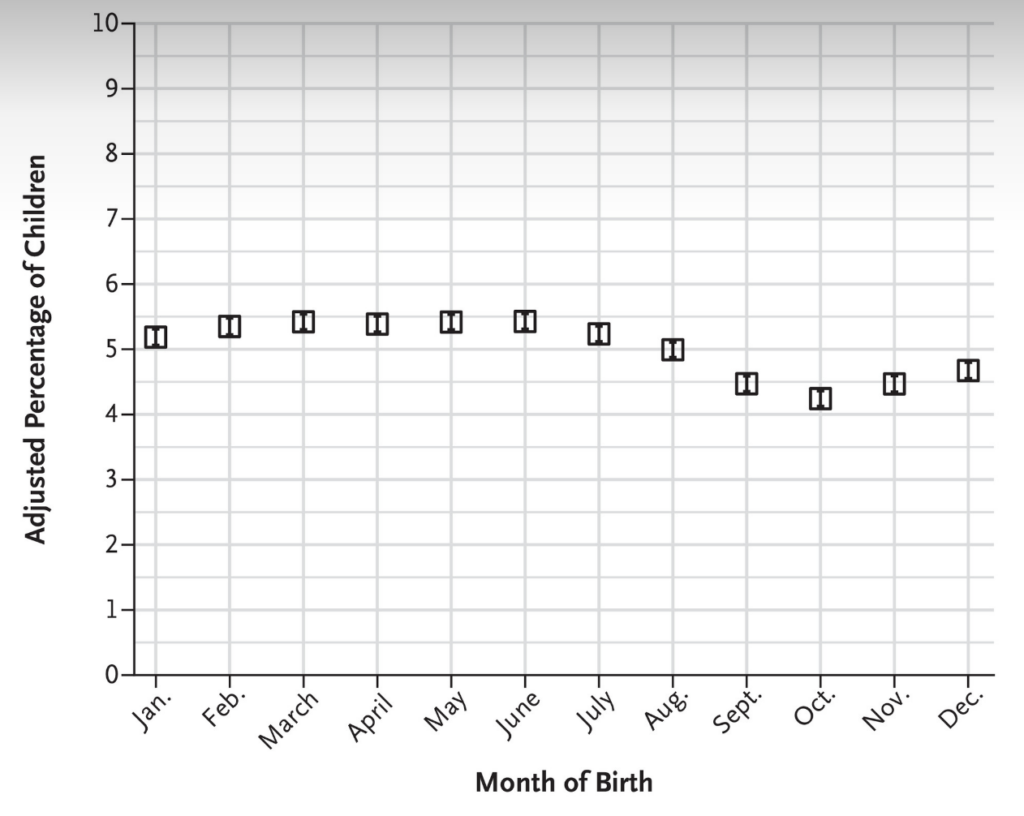
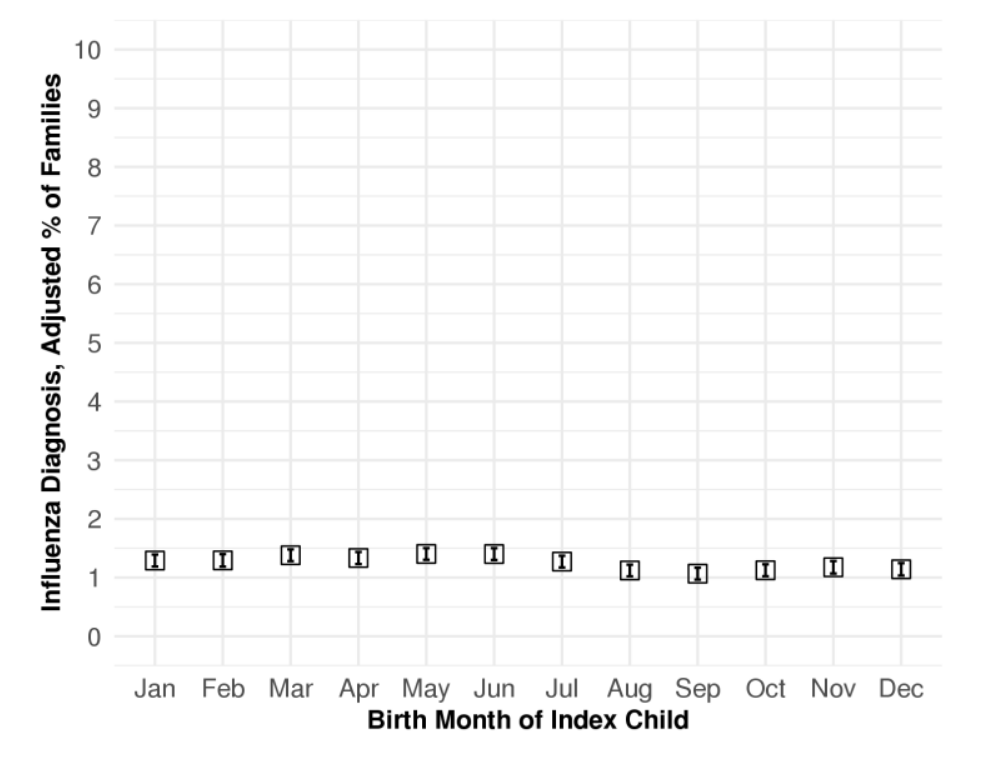
💉 This older paper from USA (2020-07-08) reports that babies born in the fall are more likely to get an influenza vaccine than babies who are born in the summer. The theory goes that if a baby has it’s one-year checkup in the fall, when flu vaccination season is in full swing, that the kid is likely to get a shot. If their one-year checkup is in the summer, they are not as likely to.
The study’s numbers bear that theory out: a little more than half of the kids born from September to December got flu shots, while only 42% of kids born in July got a flu shot.
More flu shots for babies means fewer flu cases in those kids:
It also means slightly fewer cases in older family members:
💉 This recent article (2026-06-01) about this (paywalled) paper (2026-06-01) quantifies the value of vaccination: during the 2022-23 influenza season, for every 100 kids vaccinated, about 11 vaccinated toddlers did not catch the flu. (Different years’ vaccines have different effectiveness; it ranged from 9.3 fewer cases per 100 in the 2016-17 season to 14.3 in the 2019-2020 season. (That paper apparently did not look at how many fewer adult flu cases there were.)
RSV
Vaccines
💉 AGAIN This paper from USA (2026-06-05) reports that babies born to women who got the maternal RSV vaccine (RSVpreF) had about a 70% lower risk of getting hospitalized for RSV.
Measles
Pathology
This report from Texas (2026-05-28) about the South Plains outbreak says:
- about 20% of all the measles cases required hospitalization;
- 90.7% of the cases which were hospitalized were under 18 y/o;
- 88.9% of the cases which were hospitalized had no underlying conditions;
- 100% of the cases which were hospitalized were unvaccinated or had unknown vaccination status.
They also described the bad things that happened to the hospitalized patients, including how 70.4% required supplemental oxygen.
Transmission
According to the Government of Canada Measles and Rubella Monitoring Report (updated 2026-06-01), in the week ending 23 May 2025, the following jurisdictions had the following number of new measles cases:
- Canada: 11;
- Manitoba: 7;
- Ontario: 2;
- Alberta: 1.
Bundibugyo
Transmission
This analysis from US CDC (2026-06-05) estimates that ten thousand to twenty thousand people will die in the current outbreak. 😬 This analysis from US CDC (2026-06-05) estimates that not many of them will be in the USA, at least not at first.