
Multiple Pathogens
💊 Metformin seems to be a bit of a wonder drug. It helps Type 2 diabetics, people with polycystic ovary syndrome, and it inhibits weight gain. Studies of using metformin to treat or prevent COVID-19 and Long COVID are mixed, but on balance it tends to help, and it helps some groups with metabolic disorder a lot.
This press release from USA (2026-04-06) says that metformin mimics intense exercise. It raises the levels of N-lactoyl-phenylalanine (Lac-Phe) which is associated with intense exercise. (NB: this study was not the first to find that metformin raised Lac-Phe or that exercise stimulated Lac-Phe, but it’s got a good enough discussion and I don’t feel like chasing all the references.)
Exercise itself is definitely a “wonder drug”, helping just about every health measures. If metformin mimics exercise, then no wonder it is so useful!
COVID-19
Long COVID
I have talked before about how stellate ganglion blocks — anethetizing one of the two vagus nerve branches and then the other — seems to do good things for significant percentage of Long COVID patients. Alas, this paper from Germany (2026-04-02) reports that stimulating the vagus nerve (via electrical signals given behind the ear) didn’t do any better than placebo. 🙁
👃👅 This paper with survey data from Austria, Germany, and Switzerland (2026-04-07) reports that 40% of the respondents had at least one smell/taste disorder:
- 29% had a hypersensitivity to smells;
- 27% hallucinated smells;
- 19% had distorted smells;
- 19% had taste impairment;
- 11% had smell loss;
Among those with a smell/taste disorder, 62% said that it hadn’t gotten better since it started.
They didn’t ask people to report on their COVID-19 history, but COVID-19 is known to mess with taste/smell. Note that this was a self-selected survey with no “control” arm, so there is always the risk that people misremembered, lied, didn’t understand the question, etc.
Vaccines
💉 Kaiser Permanente in Seattle is looking for healthy participants 18-64 for a Phase 1 trial of a nasal COVID-19 vaccination. They are coy about which vaccine it is, but the lead investigator at Kaiser is described as working with Moderna on two different vaccine studies, so I would bet it’s Moderna. The press release (2026-04-07) where I learned about this trial said that there were five other vaccination sites, but I couldn’t figure out where those were.
💉 This preprint from USA by Moderna (2026-04-04) found that Moderna was more effective during the 2024-2025 season than Novavax. The comparative vaccine effectiveness (cVE) of Moderna vs. Novavax for different ages and metrics was:
| Against | for ages | cVE |
| any medical consult | all | +31.7% |
| hospitalization | all | +40.7% |
| any medical consult | >64 y/o | +25.7% |
| hospitalization | >64 y/o | +41.7% |
Variants
This blog posting (2026-04-06) compares the age distribution for BA.3.2 infections compared to the age distribution of all non-BA.3.2 infections for five countries with age distribution data by variant, and shows pretty compellingly that kids get BA.3.2 more than they get other variants. For example, in the USA:
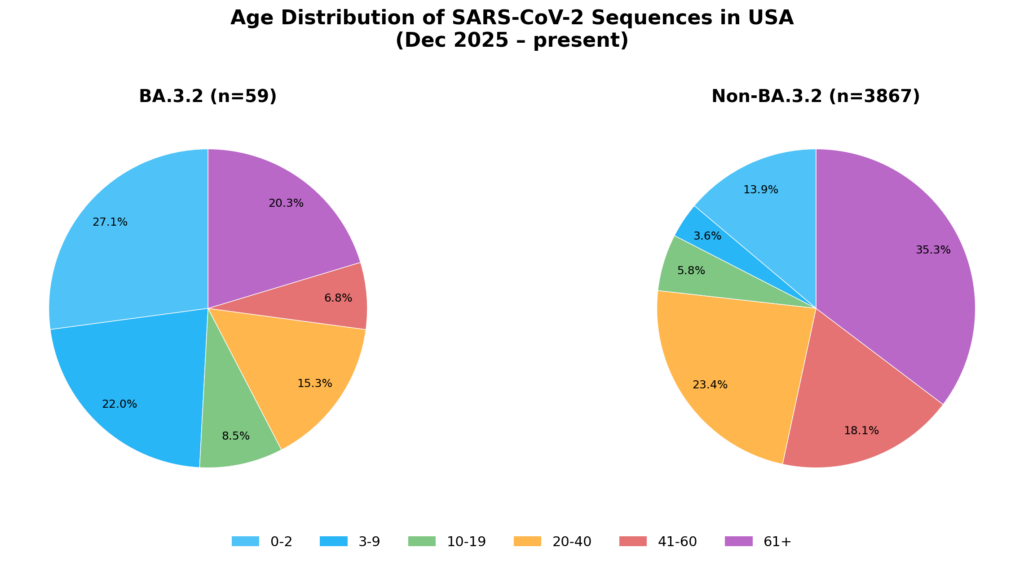
The author also showed some data that makes a strong argument against it just being that little kids hadn’t been exposed to that variant; there is some data that suggests that it has to do with a specific genetic mutation (the deletion of the ORF7/8 gene).
Influenza
Vaccines
💉 This paper from USA (2026-04-06) reports that among children, the effectiveness of the influenza vaccine against infection varied from 34% to 60% across different seasons. Across all seasons, the effectiveness differed by variant:
- 53% against H1N1;
- 43% against H3N2;
- 69% against influenza B.
This paper with data from across Europe (2026-04-06) reports that among children, the effectiveness of the influenza vaccine against PCR-confirmed influenza infection was 68% in 2022/23 and 71% in 2023/24:
- In 2022/23:
- 57% against H1N1;
- 54% against H3N2;
- 83% against influenza B.
- In 2023/24:
- 75% against H1N1;
- 40% against H3N2;
- 92% against influenza B.
💉🫀 As I have presented before, there is lots of evidence that people who get an influenza vaccine have a much lower rate of major adverse cardiac events. Is this just because it prevents getting an infection, or does the vaccine do something else?
Well, this paper from Denmark (2026-04-02) reports that even among people who had a documented history of an influenza infection in the previous year, vaccinated people still only had about half the risk of a acute myocardial infarction (AMI) or stroke. So it’s not only that an influenza vaccine keeps you from catching influenza, but it also causes less damage to you if you do get sick.
Measles
Transmission
According to the Government of Canada Measles and Rubella Monitoring Report (updated 2026-04-07), in the week ending 28 March 2025, the following jurisdictions had the following number of measles cases:
- Canada: 83;
- Manitoba: 50;
- Alberta: 28;
- Ontario: 4;
- Quebec: 1.