
Multiple Pathogens
Pathology
This paper from Ontario (2026-03-22) reports, to put it bluntly, that the “immunity debt” theory is hogwash. (The immunity debt theory says that the immune system is like a muscle, and requires exercise to stay in top form so when lockdown reduced exposure to pathogens, the immune system “got out of shape”.)
The study looked at invasive group A streptococcal (iGAS) over the past 13 years and found that each 1-standard-deviation-rise in COVID-19 cases was associated with a 14% rise in iGAS between March 2020 and August 2022 (period 1) and a 38% rise after that (period 2). So catching COVID-19 didn’t help keep the immune “muscle” in shape.
They also found that getting a streptococcal infection didn’t reduce the risk of getting a subsequent iGAS infection. So even catching a related infection didn’t help.
I don’t know who said it first, but I like it: immunity isn’t a muscle that needs exercising, it’s a reservoir that gets depleted.
Recommended Reading
🔴 This article (2026-03-25) gives an overview of the state of red light phototherapy. TL;DR: phototherapy looks pretty amazing. The article covers more than just infectious diseases, but I think this is a potentially very exciting area. (I am working on a page just on red light phototherapy, but it’s taking a while and I keep finding new material!)
This article (2026-03-23) discusses the five stages of a pandemic. Apparently there’s historical precedent for what happened with COVID-19:
- Deny that there’s a problem.
- Panic. Scramble to deal with the (real) problem.
- Get weary and push back against mitigation measures.
- Get angry and search for scapegoats.
- Pretend it never happened.
COVID-19
Long COVID
🩸 This paper from Germany (2026-03-16) found that children with Long COVID had measureably worse vascular characteristics than controls, including 8.5% lower microvascular flow index, 17% lower total vessel density, and 23% lower proportion of perfused vessels.
🐁💉 This paper (2026-03-24) reports that taking IgG from Long COVID patients and injecting it into mice caused the mice to be hypersensitive to pain. This hypersensitivity lasted at least 15 days.
Two years later, the study did new blood draws from the same Long COVID patients and injected IgG into new mice, and again, the mice got hypersensitive to pain.
They also looked at subgroups. Based on some blood characteristics, they grouped human patients into three groups. After grouping, they looked at how the groups’ protein regulation varied from controls, and described them as follows:
- LC-1: nervous system tissue;
- LC-2: skeletal muscles;
- LC-3: liver, pancreas, testis, spinal cord, and skin.
I actually simplified slightly at the beginning of this snippet: the mice that got IgG from LC-1/nervous system and LC-3/organs groups got hypersensitive to pain, but the mice that got LC-2/muscles IgG did not get hypersensitive. However, the LC-2/muscles mice had a modest but statistically significant reduction in walking distance on one test, while the LC-1/nervous system and LC-3/organs groups did not.
This study is important because:
- it supports the idea that antibodies which attack one’s own body is a/the mechanism behind Long COVID;
- it has a nice technique for classifying human Long COVID patients;
- it provides a way to give mice something very much like Long COVID, which makes it easier to test therapies.
This paper from China (2026-03-27) reports that compared to people with a single COVID-19 infection, the risk of getting Long COVID was:
- 2.01 times higher for people with two infections;
- 2.19 times higher for people with three infections;
- 3.04 times higher for people with more than three infections.
COVID-Related Excess Death and Sickness
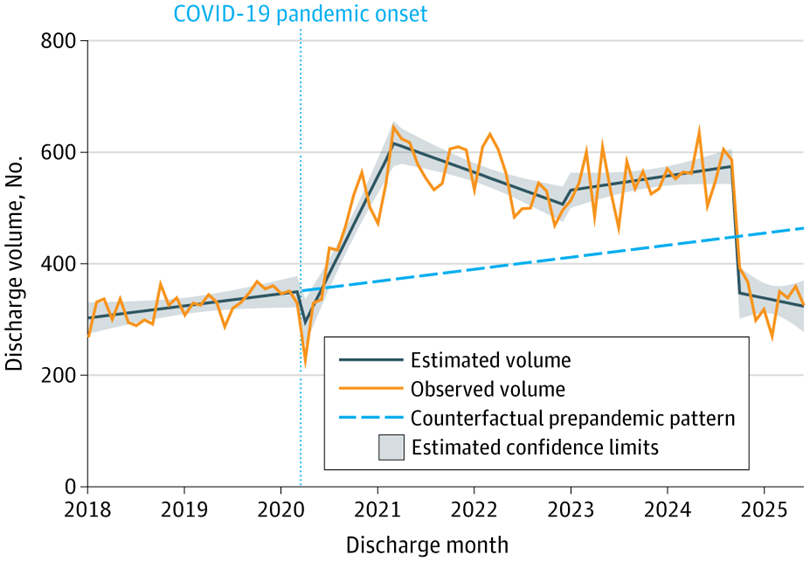
This paper from USA (2026-03-23) reports that eating disorders went up a lot at the start of the pandemic, but that they fell back down to pre-pandemic levels in October 2024.
Transmission
This paper from/about Africa (2026-02-06) makes the claim that COVID-19 lockdowns — developed as a mitigation measure for wealthy countries with relatively low-density housing — were harmful for low/medium-income countries with high-density housing.
- When a lot of people are forced to spend all their time quarantined at home, and home is a crowded one-room dwelling, this will make transmission worse than if you let people live their normal life — which they mostly spend outside, where transmission is lower.
- In some places, the movement restrictions restricted law enforcement abilities, and banditry/theft/thuggery/murder increased.
- Poorer countries tend to also have a younger population, and so are less vulnerable to COVID-19.
- Poorer countries are less able to support people in lockdown, and there are more poor who need support in poor countries. This meant people were less likely to comply: people gotta eat!
- The COVID-19 response took up an enormous fraction of low/medium-income countries’ public health budget, much higher than in wealthier countries. This meant that vaccination for other childhood vaccines rates dropped.
- The focus on COVID-19 meant that other tests (e.g. for malaria) became harder to get.
- The mitigation measures caused great economic harms, which caused many countries to take out loans, which were tied to future austerity. That austerity is now happening, and causing harms.
- In some places, child marriage and prostitution rose significantly, as girls’ bodies were monetized to replace lost family income.
- Violence against women rose significantly.
- People got angry at the government for enforcing stupid, harmful policies. (They are still angry.)
Something that they didn’t mention that I think is relevant is that poor countries tend to be closer to the equator, thus warmer, and thus people spend a greater fraction of the year with windows open and/or outside.
Vaccines
💉 There are some anti-vaxxers who say that the risk of sudden death is higher if you get a COVID-19 vaccine. This paper from Canada (2026-03-19) reports that no, actually, the risk of sudden death is almost twice as high in people who do not get a vaccine as in people who do get a vaccine. Vaccines are good, actually.
Variants
I have seen a number of breathless articles about BA.3.2 like this one (2026-03-24) warning that BA.3.2 is coming, lock all your doors, hide all your children! Me, I don’t think BA.3.2 is all that scary: it’s been around for a long time (see this preprint from May 1 last year!).
If BA.3.2 were spreading fast, I would expect that we would have seen evidence last year, but it’s still not taking off. For example, here’s a variant picture of Canada:

BA.3.2 is taking more “market share” in Europe, but it’s still not dominating. In Europe, JN.1.8.1 is holding its own against BA.3.2.*.
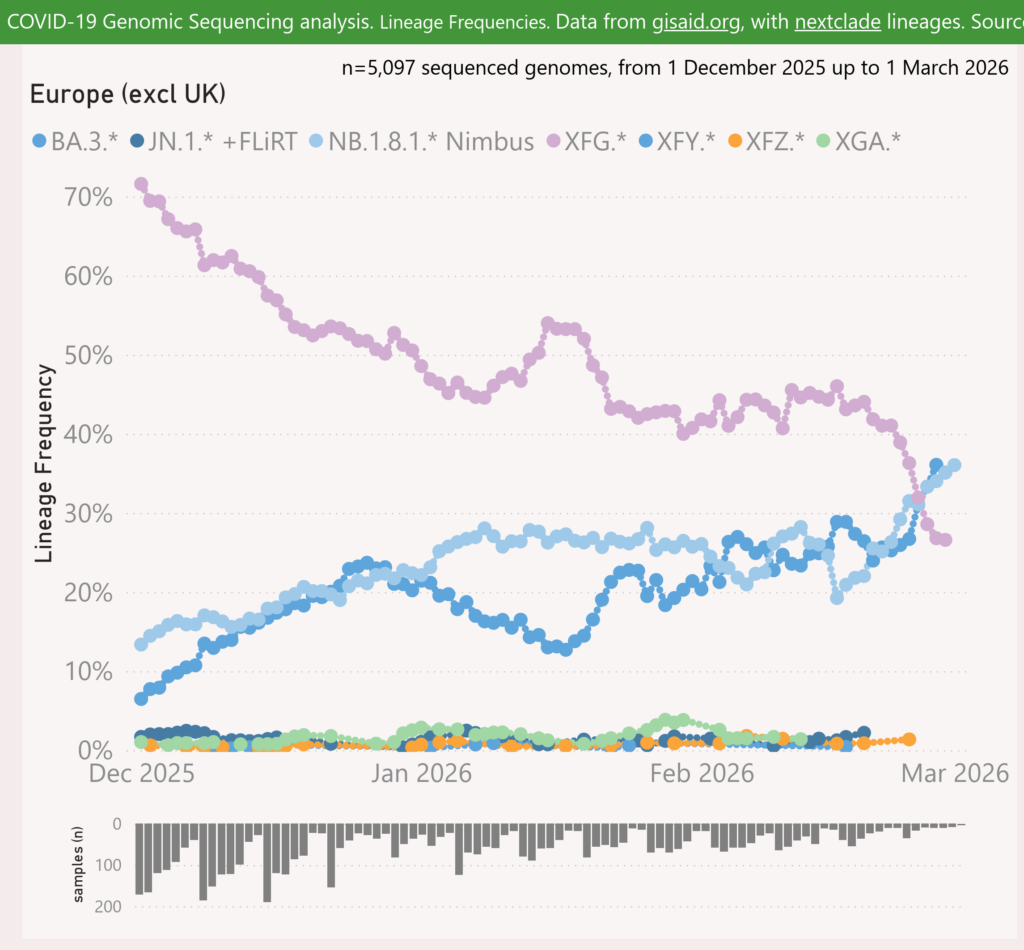
Even the omg articles will occasionally admit that there’s no evidence that BA.3.2 transmits any faster or has nastier symptoms. (Maybe it’s more evasive of the current vaccines, but very few people are even getting vaccinated these days anyway. :-/)
The only thing that might concern me is that maybe kids are more susceptible to BA.3.2 than other variants — but the only evidence I have for that is this one Bluesky thread (with no links where I could confirm the numbers).
By the way, the province’s wastewater surveillance page hasn’t detected any BA.3.2 genomes (yet).
This paper from UK (2026-03-24) argues that the immunity we humans have developed against COVID-19 have reduced the chances that we’ll get another crossover coronavirus epidemic.
I am skeptical, given that even with the number of times that we humans have developed COVID-19 hasn’t stopped COVID-19 from circulating.
This paper (2026-03-25) reports that SARS-CoV-2 is significantly constrained in how it can evolve. The authors ran simulations/calculations of stability across many many recorded variants’ genetic sequence to measure, essentially, numbers for how good they were at maintaining a stable, folded protein. They showed that over time, this stability metric (“the constraint predictor score”) got higher and higher, to the point where it hasn’t really budged since Omicron started. The stability metric looks kind of stuck, like it can’t get any better. If I understand correctly, that would suggest that COVID-19 isn’t going to get a lot worse; it’s as bad as it is going to get.
Mitigation Measures
🧠 This paper from USA (2026-03-24) reports that children ages 3 to 11 were slower to develop executive function skills after the pandemic compared to pre-pandemic children. They blamed it on the effects of the pandemic, including parental stress, social isolation, and inconsistent access to traditional education and care. Those certainly might be factors but they don’t appear to have considered at all the effects of kids catching an illness with known neurological effects. 🙄
Treatments
🔴 This older paper from Brazil (2022-12-07) reports that patients hospitalized for COVID-19 who received phototherapy reduced hospital stays from a median of 11.7 days (in controls) down to 8 days. A number of tests on subfunctions — pneumonia severity, pulmonary snoring, various blood measures, Maximal Expiratory Pressure, various cardiopulmonary functions, and oxygen intake — showed that the phototherapy cohort had significantly better measures that the controls.
Recommended Reading
This article (2026-03-26) points out that governments in Canada are euphemizing the hell out of “airborne”, and points out that as long as they don’t use the word “airborne”, they can get away with issuing surgical masks (“baggy blues”) instead of being legally obligated to issue N95s to health care workers. This puts health care workers at risk!
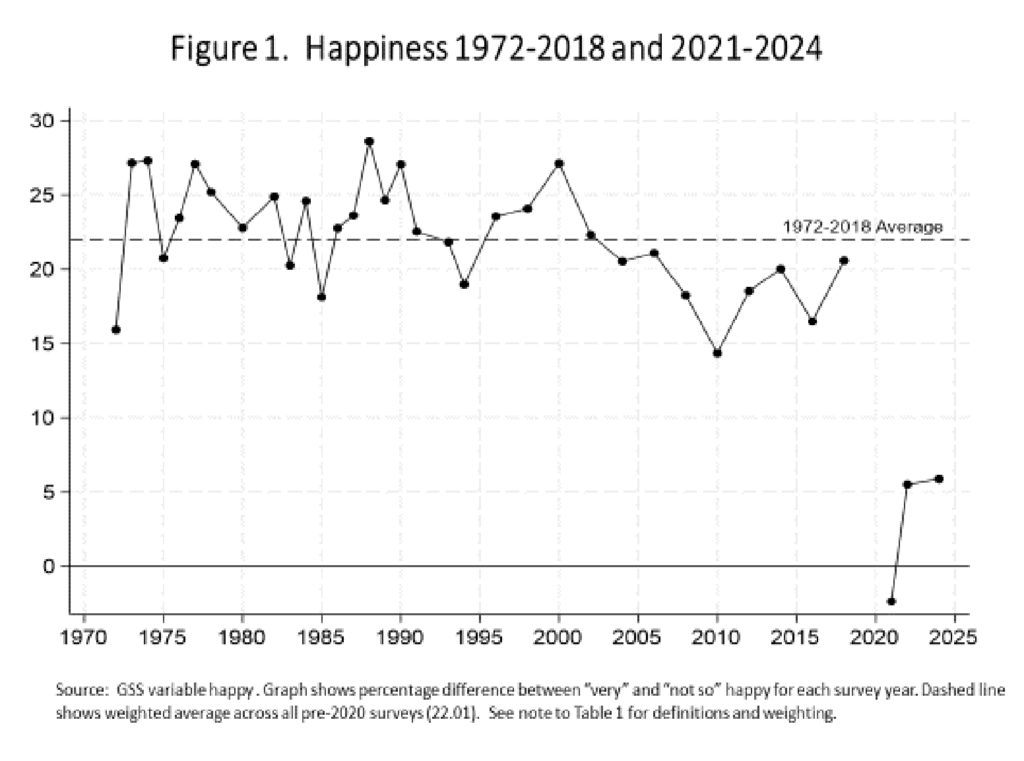
This article (2026-03-27) about this working paper (2026-03) reports that Americans got a lot unhappier in 2020, and they have not recovered.
Measles
Transmission
According to the Government of Canada Measles and Rubella Monitoring Report (updated 2026-03-23), in the week ending 14 March 2025, the following jurisdictions had the following number of measles cases:
- Canada: 78;
- Alberta: 38;
- Manitoba: 37;
- Ontario: 2;
- Quebec: 1.