
COVID-19
COVID-Related Excess Death and Sickness
🤰 This paper from USA (2025-01-01) reports babies who were exposed to COVID-19 while in the womb had neurological developmental issues compared to babies who were not exposed. Compared to controls, exposed children:
- had measurable differences in brain volumes at 2 weeks of age;
- had lower cognitive scores;
- had higher scores on measures of internal distress (e.g. depression, anxiety).
🤰 This paper from China (2025-12-23) reports that eggs for IVF which are taken while the mother has a COVID-19 infection have wonky levels of various immune system things. The umbilical cord blood of the newborns has some wonky levels, which the authors worry will affect the babies’ immune systems.
🤧🛌 This paper from Sweden (2025-12-29) reports that people who had COVID-19 were more likely to get infectious mononucleosis due to Epstein-Barr virus. Compared to people without COVID-19 infections:
- people who had a postive PCR test had a 61% higher risk of getting mono;
- people who were hospitalized for COVID-19 had a 471% higher risk of getting mono.
Long COVID
💉This paper from USA (2025-08-06) says that the more COVID-19 vaccines people had, the more protection from Long COVID they had. Among patients with a documented COVID-19 infection, compared to unvaccinated people, vaccinated people had these lower risks of Long COVID:
- 1 vaccination: 23% lower risk;
- 2 vaccinations: 27% lower risk;
- 3 vaccinations: 36% lower risk;
- 4 vaccinations: 71% lower risk.
They also reported that people who had Paxlovid had a 95% lower risk of Long COVID and people treated with remdesivir had a 69% lower risk. Addendum: some readers pointed out that 95% is way higher than what similar studies found (~25%). A reader double-checked the paper’s numbers and found the Jan-Nov 2022 cohort had a 86.5% lower risk with Paxlovid and the Oct 2020-Nov 2022 cohort had a 82.7% lower risk with Paxlovid. We are seeking further expertise.
There are two possible explanations for why more vaccines mean a lower risk of Long COVID.
- perhaps the more different strains of COVID-19 your immune system is exposed to,
the better it learns how to fight, the more broadly-effective antibodies your immune system creates; - perhaps the number of vaccinations you’ve had correlates with how recently you’ve had a vaccination, and more recent vaccinations presumably will be better matches for the currently-circulating strains.
💊 This preprint from Spain (2025-12-19) reports that the Long COVID was much much lower in people who took antihistamines regularly (for other conditions) than those who did not. There was also a lower risk of clotting disorders in the antihistamine group.
💸 This paper from USA (2025-01-05) estimated that the lost labour cost from Long COVID in 2022 in the USA was more than 12 BILLION (with a B!) US dollars.
💸 Meanwhile, this paper from USA (2025-01-03) estimates that people with Long COVID have average medical expenses 40% higher than people without Long COVID.
Mitigation Measures
😷👀🧠 This paper from France (2025-01-03) says that seeing masked faces instead of naked faces does not disrupt their visual processing. (Related reminder: blind kids develop emotional processing just fine without seeing unmasked faces.)
If someone is that worried about babies not seeing smiles, draw a smile on your mask. Or wear an Omnimask.
Vaccines
💉 This paper from South Korea (2025-01-03) reports that COVID-19 vaccinations help reduce mortality in COPD patients — even the ones that did not get COVID-19 infections! It wasn’t a small effect, either. The rate of death per 10,000 COPD patients based on vaxed/unvaxed vs. infected/uninfected was:
| vaccinated | unvaccinated | |
| didn’t get COVID-19 | 281 | 2106 |
| got COVID-19 | 661 | 4510 |
Now, there are some reasons to question this results: the number of people in the study was smallish (hundreds and not thousands), confidence ratios were wide, and it might be that people who get vaccinated just take care of their health better than people who do not get vaccinated. It might also be that people who were vaccinated got fewer asymptomatic (but still damaging) COVID-19 infections.
Transmission
This paper from USA (2026-01-05) reports on COVID-19 adverse outcomes over two years in the USA:
| season | metric | count |
| 2022-23 | cases | 43.6M |
| 2022-23 | outpatient visits | 10.0M |
| 2022-23 | hospitalizations | 1.1M |
| 2022-23 | deaths | 101K |
| 2023-24 | cases | 33M |
| 2023-24 | outpatient visits | 7.7M |
| 2023-24 | hospitalizations | 879K |
| 2023-24 | deaths | 100K |
Yes, this is the USA, not Canada, but I think we can still learn from it. In particular, note that despite around a 25% drop in cases from one season to the next, the number of deaths was almost identical in the two seasons. Also note that the percentage of cases that turn into hospitalizations was pretty steady at around 2.5%. Deaths per hospitalization actually went up quite a bit.
The paper also reports that in 2023-24, people over 65 were only 17.8% of the population, but
- 47.9% of the COVID-19 cases;
- 64.3% of the outpatient visits;
- 67.6% of the hospitalizations;
- 81.2% of the deaths.
Note that this means that about 1-in-5 of the COVID-19 deaths were in people under 65.
💉 This paper from UK (2026-01-03) reports that vaccination or infection with COVID-19 doesn’t really affect immunity to the “common cold” coronaviruses (OC43, HKU1, 229E, and NL63). Too bad.
Treatments
This paper (2025-12-29) reports that computer simulations show that plantaricin K — a byproduct of the Lactobacillus plantarum bacteria found in many fermented foods and the Kirkland probiotics in my medicine cabinet — binds to the COVID-19 spike’s S2 protein.
Pathology
This paper from USA (2025-12-23) reports that people with multiple sclerosis have higher risks of bad COVID-19 outcomes compared to people who don’t have MS:
- 34% higher risk of hospitalization;
- 46% higher risk of death;
- 61% higher risk of Long COVID
- 37% higher risk of severe disease.
Recommended Reading
This article (2025-01-08) talks about the benefits of saline nasal irrigation and sprays. (It’s not just me, folks!) Addendum: some readers point out that freezing is not an adequate way to purify water. BOIL IT.
Influenza
Vaccines
💉 This article (2026-01-05) reports that Moderna is asking the USA for approval of an mRNA influenza vaccine (mRNA-1010). (The results of the Phase 3 trial are in this paper from USA (2025-12-15), but the details are paywalled.) 🎉The article says that mRNA-1010 is 27% more effective than existing flu vaccines.
The current USA federal government is rather hostile to mRNA vaccines, but I don’t believe the Government of Canada is. Approval of mRNA-1010 makes the approval of a combo influenza/COVID-19 shot much more likely.
This paper from Italy (2026-01-08) reports that babies born to mothers who got influenza vaccine were 30% less likely to be hospitalized for influenza. (The paper also reported that maternal whooping cough vaccine dropped the babies’ risk of hospitalization for whooping cough by 11%, but ignore this because it’s in the Influenza section and I didn’t feel like making a whooping cough section, shhhhhh.)
Transmission
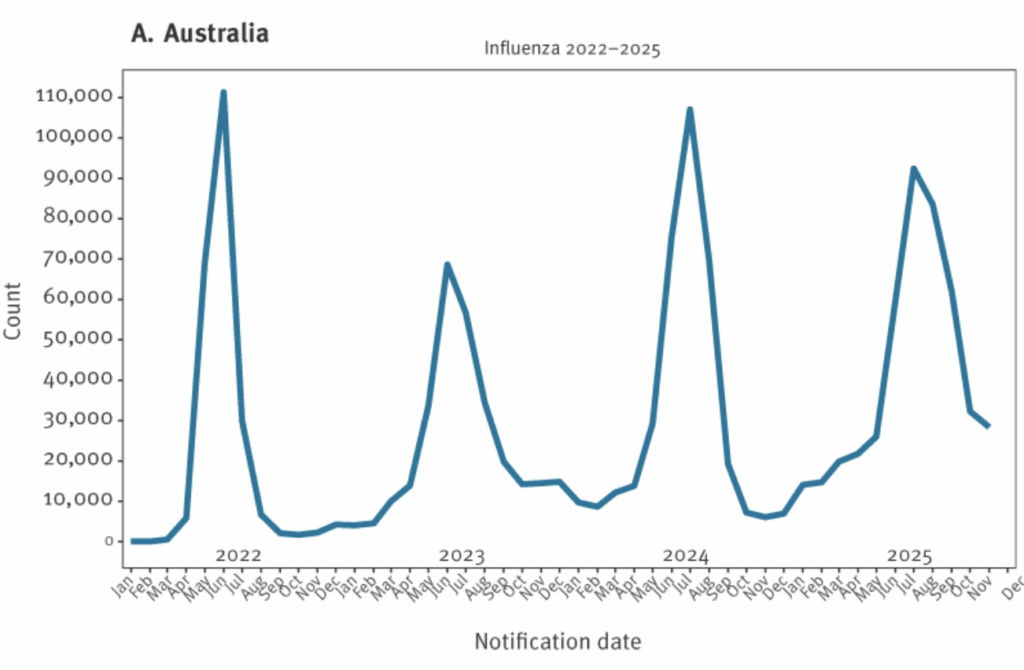
This article from Australia (2025-01-07) says that Australia is still having a relatively high number of influenza cases now, in January — their summer. Normally their influenza season is from June to September.
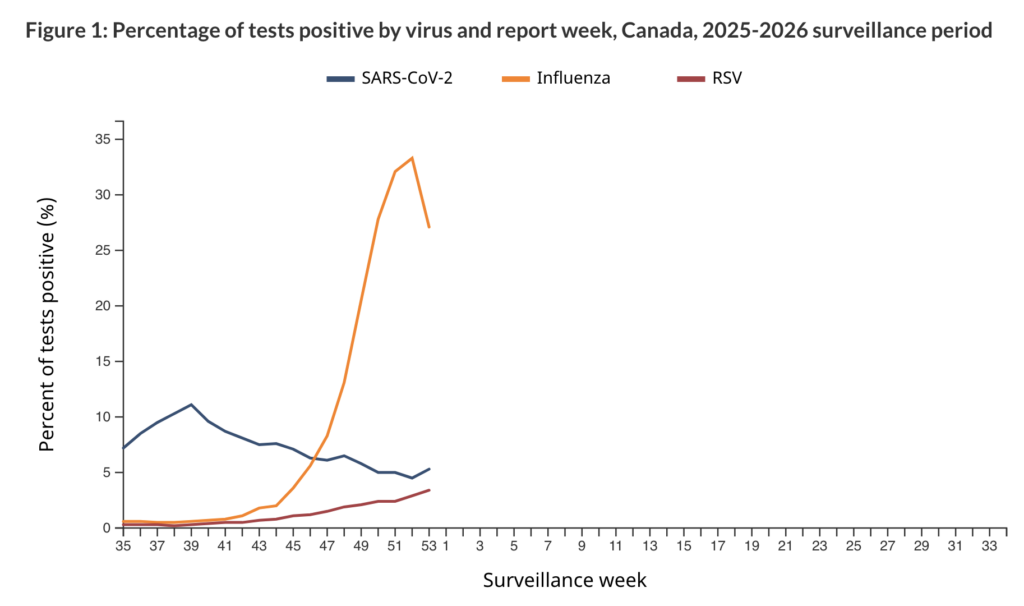
On the other hand, if Canadian national data from the holiday period can be trusted, maybe flu has peaked. From the Canadian respiratory virus surveillance report with data from 2026-01-09:
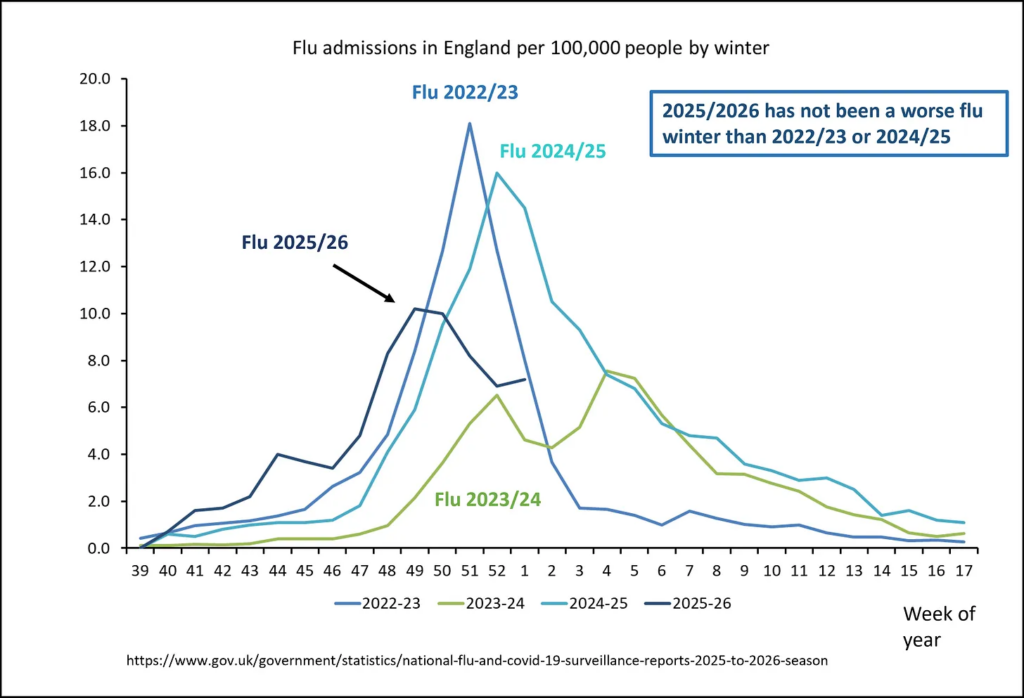
Also, this blog post (2026-01-08) reports that while England had a very early start to flu season this year, its peak was not very high:
The US has possibly peaked as well, if you trust holiday data.
RSV
Vaccines
🤰💉 This article from CIDRAP (2025-01-09) reports that a maternal RSV vaccination did not increase the risk of any birth complications (e.g. pre-term births). Good to know.
Measles
Transmission
According to the Government of Canada Measles and Rubella Monitoring Report (updated 2026-01-05), in the week ending 27 December 2025, the following jurisdictions had the following number of measles cases:
- Canada: 16;
- Manitoba: 12;
- BC: 3;
- Ontario: 1.