
Multiple Pathogens
Recommended Reading
This post by Biobot (2026-09-01) discusses exactly how they normalize their wastewater readings to account for variations in the wastewater stream. TL;DR: they use a combination of the pepper mild mottle virus concentration (which changes over time, as apparently peppers have outbreaks too) and the quantity of water in a week (which can be influenced by rainwater or people drinking a lot).
COVID-19
Vaccines
This paper from USA (2026-06-06) reports that women who got a COVID-19 vaccination during the follicular menstrual phase (first day of bleeding up to ovulation) where 35% more likely to have vaccine side effects than women who got a vaccination during the luteal phase. However, they also caught COVID-19 later — 35 days later, on average. (I don’t have information on what percentage got sick of each cohort.)
Transmission
This paper from Denmark (2026-07-13) reports that early in the pandemic, people were 9.9% more likely to get a COVID-19 infection between two days before a grandchild’s birthday to eight days after the birthday than outside the “birthday window”. The risk was 15% higher if the child was pre-school aged. (This was despite official advice at the time not to gather during part of the pandemic.)
BC Wastewater
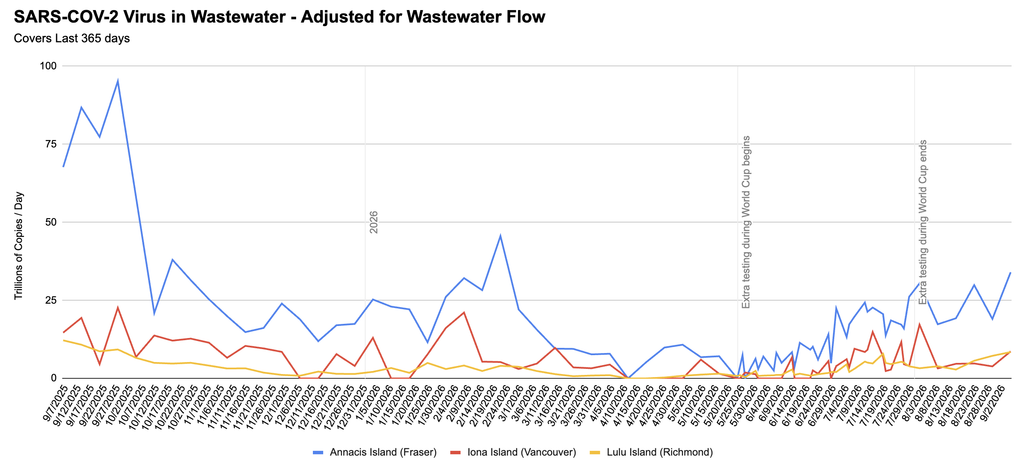
Jeff says that the province didn’t provide their normal wastewater information this week. He was able to root around and find the data, but for some reason the data he found doesn’t have as many significant digits as the regular data. 🤷♀️
The wastewater levels are continuing to go up.
💩💧 From Jeff’s wastewater spreadsheet with data through 6 September 2026:
Influenza
Transmission
This paper from USA (2026-09-10) reports — surprise surprise — that Americans in their study don’t isolate as long as the US CDC says they should. They found that only 21% of people isolated from family members at all (and even then, only for an median of two days), and only 80% isolated from the community (for a median of four days). (The US CDC says to isolate until 24 hours after the fever goes away, and follow post-isolation procedures for five more days. Based on their subjects’ symptoms, they should have been isolating for an median of six days.)
The authors also found that viral load peaked at a median of four days after symptom onset. It dropped to negligible levels in almost 100% of people after the sixth day post-isolation (so the “isolate for one more day and be careful for six days after your fever breaks” actually looks like pretty good guidance.
It looks like Flu A transmission is definitely starting to slooooowly rise in the US and maybe in Canada. The absolute level is still quite low, however.
Measles
Transmission
🎉 According to the Government of Canada Measles and Rubella Monitoring Report (updated 2026-09-14), in the week ending 5 September 2026, the following jurisdictions had no new measles cases!! (I don’t expect this to last, given how many spots are erupting in our southern neighbour, but it’s a nice break.)