
General
Recommended Reading
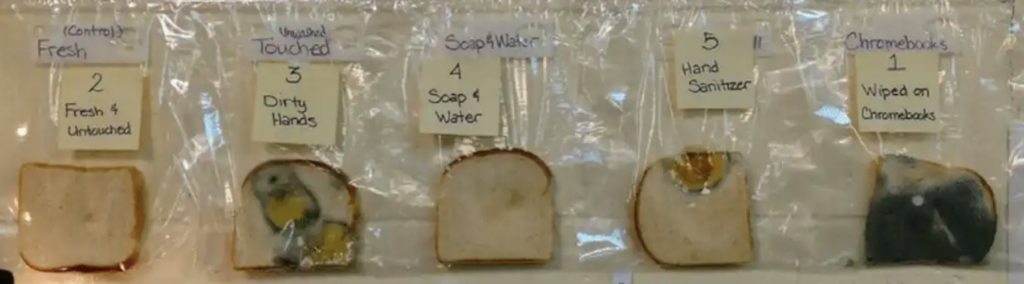
🙌🧴🍞🦠🤢 This older article (2019-12-10) reports on a simple experiment that a schoolteacher did with her class: she took slices of bread and had kids handle them after various hand hygiene techniques. Tongs? The bread was immaculate. No handwashing? Covered with mold. Spoiler: hand sanitizer is not as good as washing with soap and water.
COVID-19
Long COVID
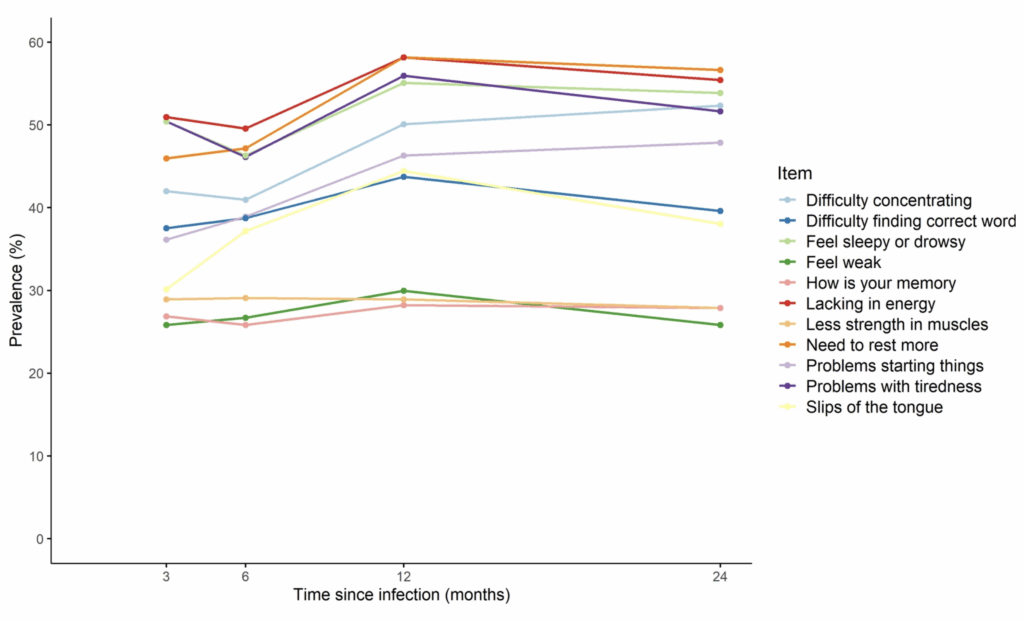
😬 This paper from UK (2025-11-20) reports that a lot of kids who got COVID-19 reported fatigue, and by and large they didn’t get much better.
- 61.6% of the kids had fatigue (77.1% for females) at at least one point compared to 21.5% pre-pandemic;
- 15.9% of the kids had fatigue at every followup point.
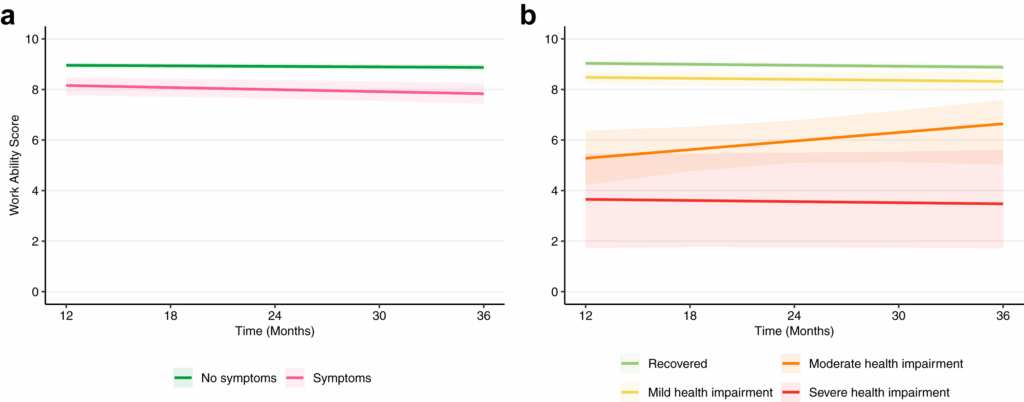
This paper from Switzerland (2025-11-20) reports that adults with severe Long COVID don’t get better, either. People with moderate impairment did get better, although slowly.
This paper from USA (2025-11-20) reports that people with Long COVID had elevated levels of T-cells specific to SARS-CoV-2, chicken pox/shingles, and/or Epstein-Barr Virus.
🎉💉 This paper from USA (2025-12-05) reports that vaccinated adolescents have a 36% lower risk of Long COVID than unvaccinated adolescents.
😲 This paper (2025-11-25) reports that when scientists put IgG antibodies from Long COVID patients with pain and fatigue into mice, the mice developed higher pain sensitivity. When they put IgG antiboties from Long COVID patients with fatigue but not pain into mice, the mice didn’t develop higher pain sensitivity.
This suggests that pain in Long COVID probably has an autoantibody component.
💸 This paper from UK (2025-11-27) quantifies how much more Long COVID patients use the healthcare system than others. The hard cold cash metric says that Long COVID patients cost the healthcare system £704.80 per year compared to £349.60 for contemporary non-COVID patients — just about double. (And note: I read a lot of complaints from Brits about how the NHS does almost nothing for Long COVID patients.)
COVID-Related Excess Death and Sickness
💉😲🎉 This paper from France (2025-12-04) compared 22.7 million vaccinated adults under 60 in France to 5.9 million unvaccinated adults under 60. They found that vaccinated people were 25% less likely to die than unvaccinated people during an average of 45 months of followup, despite the average vaccinated people being (very slightly) older than the average unvaccinated person and having more cardiometabolic comorbidities on average.
😲 This paper from USA (2025-11-24) reports that your risk of two auto-immune disorders significantly increases after a COVID-19 infection. Using two different electronic records databases — one for adults under 65 and one for adults over 65 — they found higher risks of Guillain-Barré syndrome and immune thrombocytopenia.
- For adults under 65,
- a +857% higher risk of Guillain-Barré syndrome after COVID-19 infection;
- a +106% higher risk of immune thrombocytopenia after COVID-19 infection.
- For adults over 65,
- a +97% higher risk of Guillain-Barré syndrome after COVID-19 infection;
- a +36% higher risk of immune thrombocytopenia after COVID-19 infection.
😲😬 This paper from Sweden (2025-12-01) reports that the incidence of diabetes in children rose 30% after the start of the pandemic, compared to the pre-pandemic rate.
🫁😬This preprint from USA (2025-09-03) reports that being hospitalized for COVID-19 gives a 19% higher risk of lung cancer compared to healthy controls.
🫀😬 This paper from Sweden (2025-11-30) reports that COVID-19 hospitalization is bad for your long-term heart health. They looked at electronic records for people who were hospitalized for COVID-19, matched comparators who never had COVID-19, and matched comparators who had COVID-19 but were not hospitalized. They report that the people who were infected but not hospitalized had a higher risk of cardiac issues in the short-term aftermath of their infection, but didn’t have a higher-risk long-term.
The people who were hospitalized, however, had significantly higher risks for many things, for longer. At the year mark, compared to the non-COVID cohort, they had:
- +75% risk of all-cause mortality;
- +70% risk of major adverse cardiovascular events;
- +28% risk of myocardial infarction.
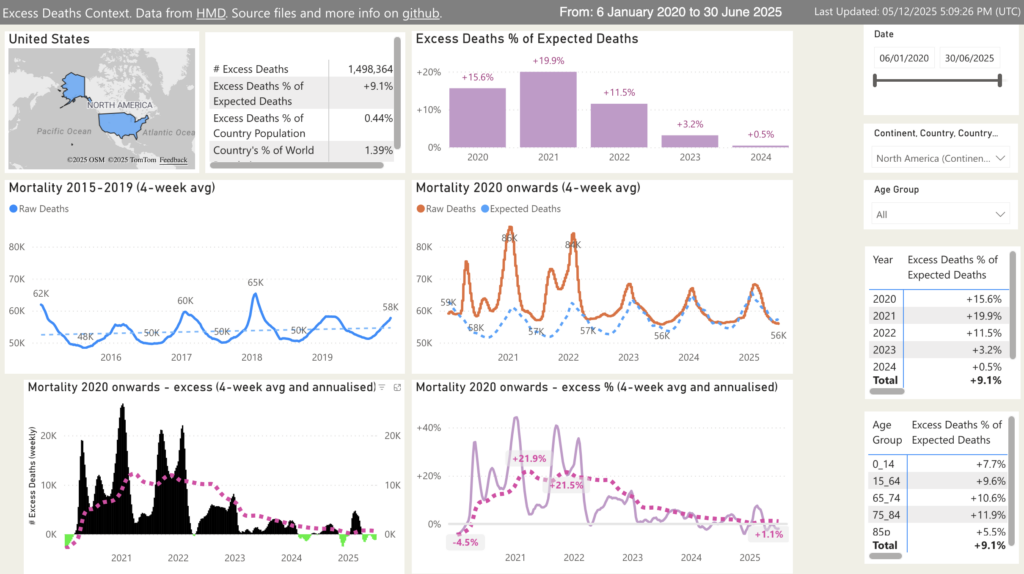
🎉☠️ This page has really nice visualizations of excess deaths in Canada (though you can choose other countries, too):
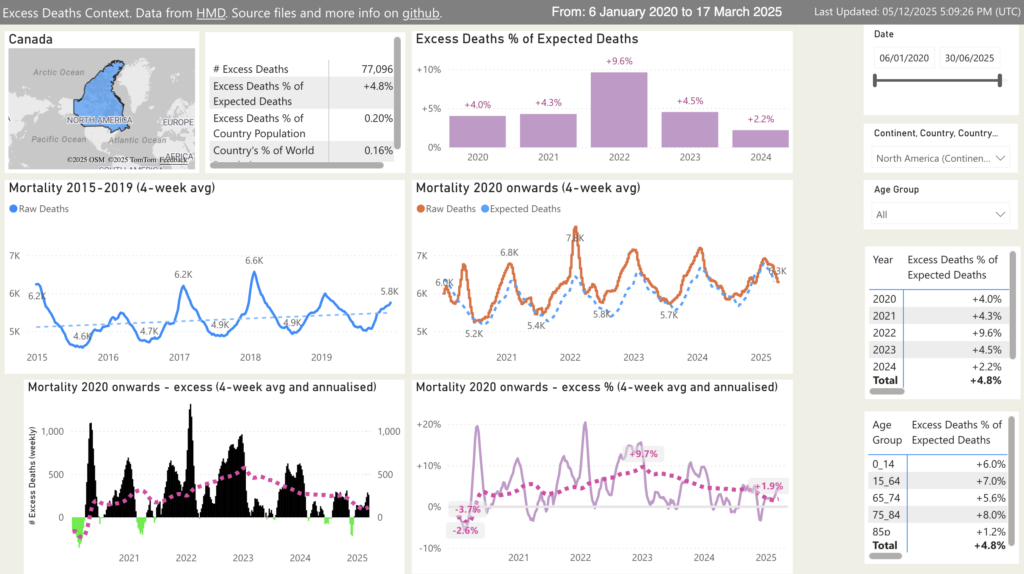
Here’s the USA, for example (note that the scales are not the same):
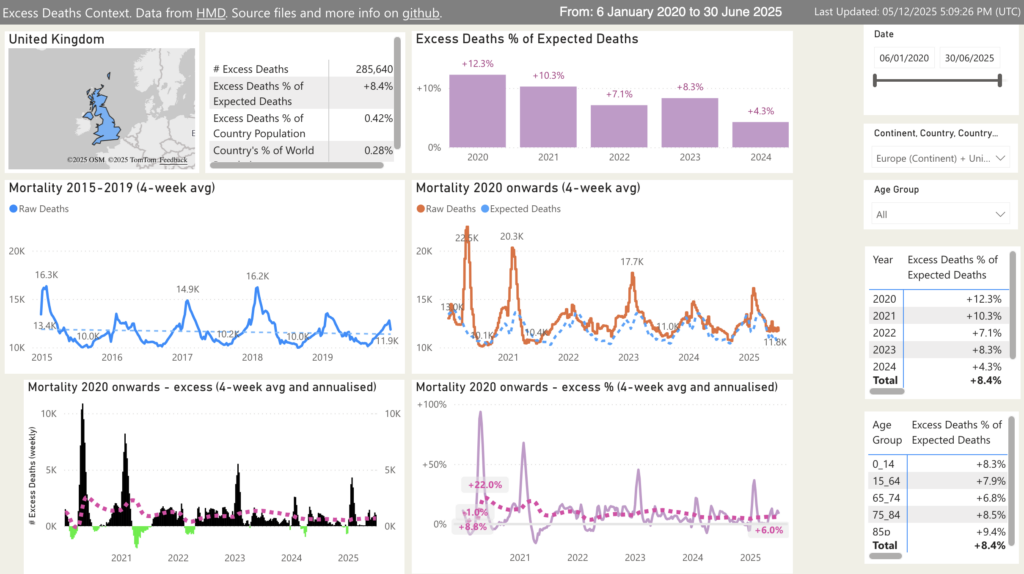
and I knew that the UK got hit hard, but I hadn’t realized it was as bad as this visualization says it was:
Treatments
🎉💊 This paper from USA (2025-11-26) reports that participants who were given metformin after a COVID-19 infection had slightly less than half the risk of Long COVID or death than people who were not given metformin after infection. The faster they got the metformin, the lower their risk was:
- people who got metformin sometime in the first two weeks after an infection had a 25% lower risk of Long COVID or death;
- people who got metformin on Day 0 or Day 1 had about a 60% lower risk of Long COVID or death.
Transmission
This paper from Switzerland (2025-11-27) looked at transmission in schools. It found that brief close proximity (avg. of 20 minutes, perhaps outside of class?) was not as big a risk as staying in a classroom for hours, especially if the ventilation was poor.
Pathology
🩸😬 This paper (2025-11-26) reports that fibrils (which I think just means “stringy-looking-things”) on the SARS-CoV-2 spike protein can make blood clots more likely to form, and — more importantly — harder to get rid of.
This paper from Catalonia (2025-11-19) reports that people with diagnosed mental health disorders were more likely to die from COVID-19 than those without mental health disorders:
- people with one mental disorder were 23% more likely to die;
- people with four or more mental disorders were 5.21 times as likely to die.
🤰😬 This paper from USA (2025-11-13) reports that babies who were exposed to SARS-CoV-2 in the womb were 29% more likely to receive a neurodevelopmental diagnosis by 36 months after birth compared to babies who were not exposed.
Third trimester exposure was worse, with babies 36% more likely to get a neurodevelopmental diagnosis. Boy babies were 43% more likely to get a neurodevelopmental diagnosis than girl babies.
Vaccines
💉😢 I used to love reading Hilda Bastian’s vaccine roundups: there were usually reports of really great results from pre-clinical trials. In the recent reports (like this one (2025-11-30) there’s still quite encouraging news from preclinical results, but now all I can see is how f slow the progress is for drugs going through clinical trials. (And even the ones which are progressing through clinical trials aren’t necessarily the ones which had the best pre-clinical results.)
Here’s a summary of what vaccines have continued past Phase 1 trials:
- Phase 3
- COVI-VAC intranasal, USA (press release 2023-05-11)
- dNS1-RBD intranasal, China (paper 2023-11-15)
- Razi-Cov Pars intranasal, Iran (paper 2024-03-15)
- Phase 2
- CyanVac intranasal, USA (press release 2024-11-25)
- Patria NDV-HXP-S intranasal, Mexico (paper, 2025-01-01)
- AeroVax inhaled, Canada (article 2025-03-11)
- Vaxart oral, USA (press release, 2025-11-05)
- Castlevax intranasal, USA (press release, 2025-11-04)
It’s not a very long list. 🙁
🎉💉 This slightly older paper from USA (2025-09-03) says that the XBB.1.5 vaccine actually was pretty durable against the COVID Classic and XBB.1.5, with a half life of 703 days for COVID Classic and 531 days for XBB.1.5. Unfortunately, the KP.2 and KP.3 strains were able to evade XBB.1.5 vaccines.
Recommended Reading
This essay (2025-11-24) by a man with Long COVID on “coerced infection” talks about the pain of having to deal with unmasked health care workers, and why it matters so much to him.
RSV
Pathology
🤰😲😬 This paper from Denmark (2025-11-28) reports that an electronic records search showed that babies who were hospitalized for RSV and had an asthmatic parent had way higher risk of asthma than babies who had neither:
- if the mother was asthmatic, the risk was 438% higher;
- if the father was asthmatic, the risk was 373% higher.
Having only RSV hospitalization increased the risk by 232%; having only an asthmatic mother increased the risk by 106%, and having only an asthmatic father increased the risk by 71%.
The researchers infected allergic mice, and were able to find the biochemical pathway that goes from
- maternal (but not paternal, they’ll have to do more research on that) house dust mite allergy plus
- an RSV-infection in the baby
to house dust mite allergy in the babies.
It’s like viruses are bad for you, who knew?
Measles
Transmission
According to the Government of Canada Measles and Rubella Monitoring Report (updated 2025-12-01), in the week ending 22 November, the following jurisdictions had the following number of cases:
- Canada: 40;
- BC: 15;
- Manitoba: 9;
- Saskachewan: 9;
- Alberta: 7.
Ebola
Transmission
🎉🎉🎉 This article (2025-12-01) says that the DR Congo’s Ebola outbreak has been declared over, yay!