
Hospital System
I missed it when it came out, but as this press release (2025-12-05) describes, the province is going to centralize certain health care administration tasks. Instead of each Health Authority having their own legal, supply chain, finance and human resources, those are all going to be consolidated into one standalone shared services organization, called BC Shared Health Services.
This might work splendidly, it might be a disaster. I am not close enough to the Health Authority inner workings to have an opinion.
Vaccines
I have finally spotted some information about the Spring 2026 BC COVID-19 vaccination campaign, on BC’s COVID immunization page (2026-04-21). They say:
B.C.’s COVID-19 spring program is expected to run from April 22 to July 31, 2026, and you will get contacted by the registration system.
They recommend a spring dose for:
- Adults 80 years and older
- Indigenous adults 70 years and older
- Residents of long-term care homes and assisted living facilities and those awaiting placement
- People 6 months and older who have been diagnosed as clinically extremely vulnerable (CEV 1 or CEV 2)
They have a weaker recommendation for:
- Adults 65 years and older
- Indigenous adults 55 years and older
It is not clear to me if people outside of the above groups are allowed to get a vaccination.
Charts
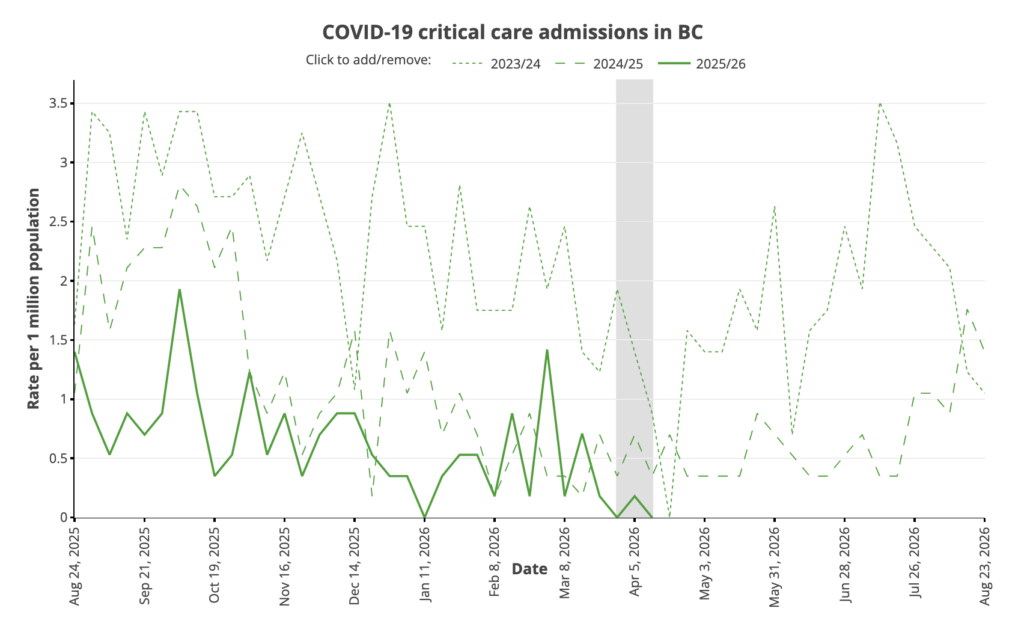
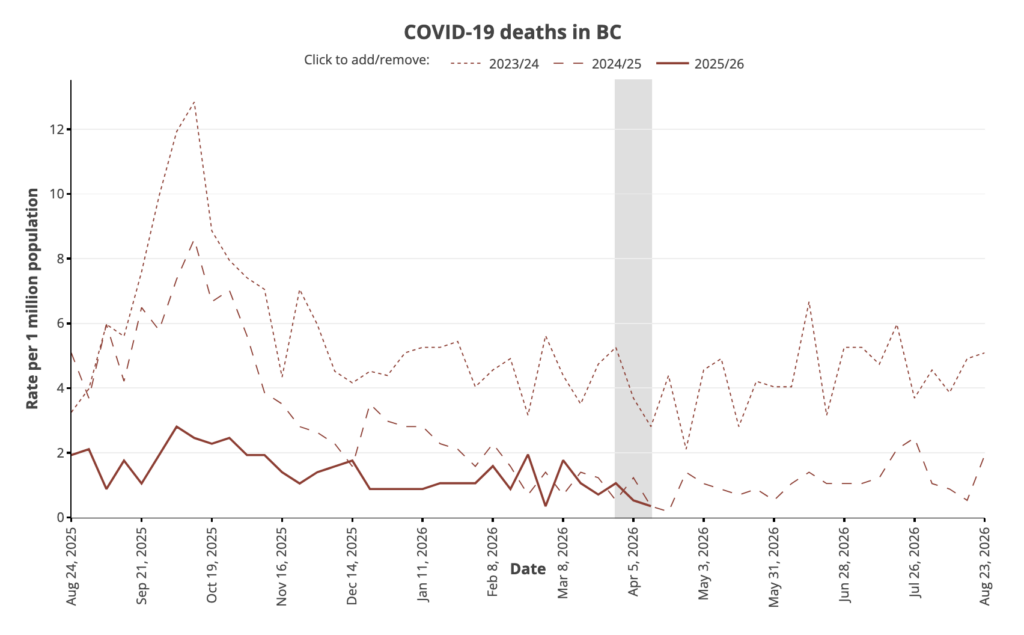
From the Viral Respiratory Outcomes page (updated 23 April 2026 with data through 18 April):

From the Viral Pathogen Characterization page:
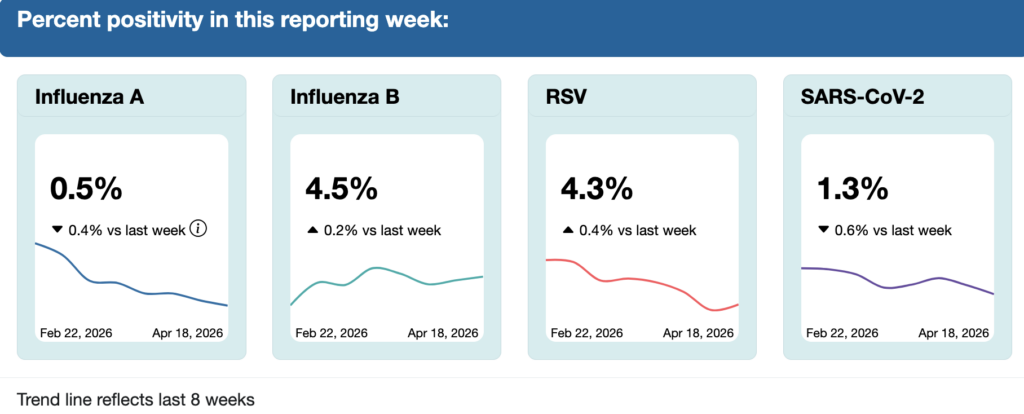
Everything is basically the same as last week. RSV, FluB, enterovirus, and parainfluenza numerically went up last week, but that just might have been noise.
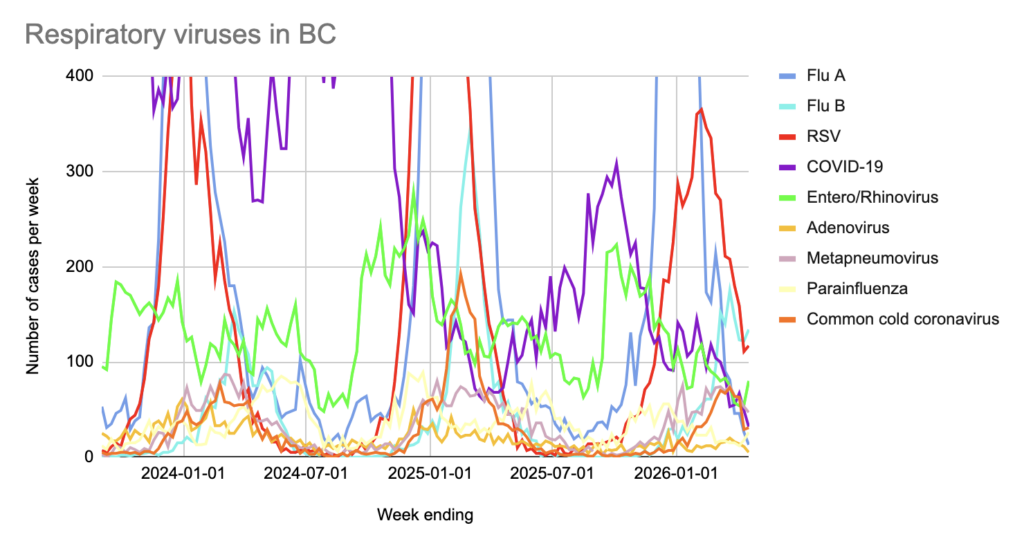
In the most recent data (ending 18 April 2026) as reported on 23 April 2026, among influenza-like illness (i.e respiratory diseases) cases that the province has test data for:
- 30.3% were influenza A or B (mostly B);
- 24.1% were RSV;
- 16.5% were entero/rhinoviruses;
- 9.7% were metapneumonia viruses;
- 6.6% were COVID-19;
- 6.4% were “common cold” coronaviruses;
- 5.4% were parainfluenza;
- 1.0% were adenoviruses.
Wastewater
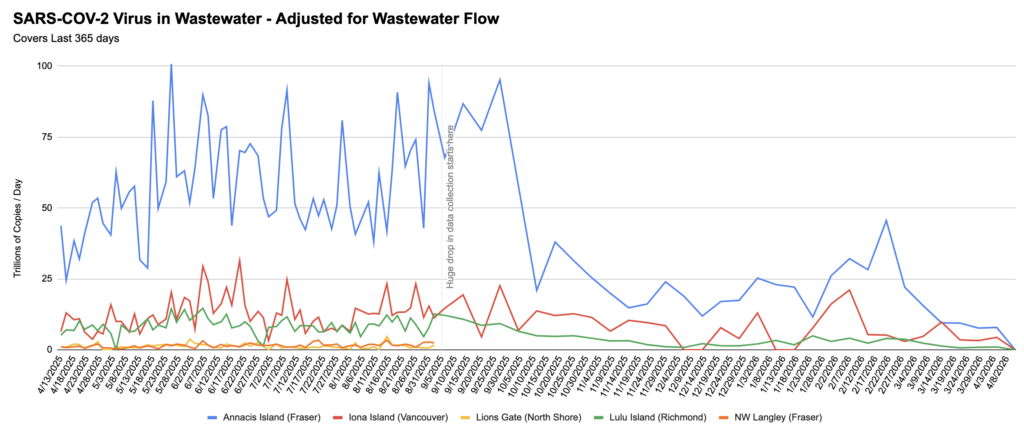
The province reported that there was zero COVID-19 in any of the three wastewater treatment plants which they are still measuring at. There are five possible explanations for this:
- there were zero people with COVID-19 in Fraser or VCH in the week ending 15 April;
- there were zero people in Fraser or VCH who deposit their feces in the Iona Island, Annacis, and Lulu Island catchment areas;
- all the measurements were done incorrectly;
- the measurements are not sensitive enough to register if there is too little material (i.e. from too few people) to measure;
- all the measurements were reported incorrectly.
I have alternate sources of data (case counts, positivity, and hospitalizations) which say there were more than zero documented cases of COVID-19 in Fraser Health and Vancouver Coastal Health who had COVID-19, so strike the first one.
It is possible that there are sick people in VCH and Fraser outside of the catchment areas of those three wastewater treatment plants. However, the three wastewater treatment plants with COVID-19 monitoring serve about 2/3 of all the VCH and Fraser residents. It seems highly unlikely that 100% of the people with COVID-19 would be in the 33% of VCH/Fraser not served by those three plants.
It is possible that the measurements were done incorrectly, but it seems unlikely that all three treatment plants would mess up their data at once.
I think it is possible that the wastewater monitoring is just not sensitive enough to notice the number of people who are contributing COVID-19 virus particles to the sewers. I had the impression, however, that PCR tests were really, really sensitive. Furthermore, it’s highly suspicious that all three plants would hit zero in the exact same week.
By elimination, I suspect a reporting glitch. It will be interesting to see what happens next week.
💩💧 From Jeff’s wastewater spreadsheet:
2 comments
Comments are closed.