
COVID-19
Long COVID
🎉 This paper from USA (2025-10-21) reports that 74.3% of Long COVID patients in a Phase 1 study of rapamycin showed significant improvements in fatigue, post-exertional malaise, and orthostatic intolerance.
COVID-Related Excess Death and Sickness
🫄 This article about this paper from USA (2025-10-30) reports that babies who were exposed to SARS-CoV-2 in the womb had a 29% higher risk of a neurodevelopmental diagnosis by 36 months after birth compared to babies who were not exposed to SARS-CoV-2 in utero. The largest risk was from third-trimester exposure (+36% risk) and for baby boys (+43% risk).
2.7% of the exposed babies got a diagnosis of autism, compared to 1.1% of the unexposed babies. Let it be noted that research shows that Tylenol does not increase the risk of autism, but that COVID-19 does.
📈 This report by a Swiss insurance company (2025-09-16) estimates that excess mortality is 0–3% in the US and 0–2.5% in the UK. They say, “we conclude that COVID-19 is still driving excess mortality both directly and indirectly”.
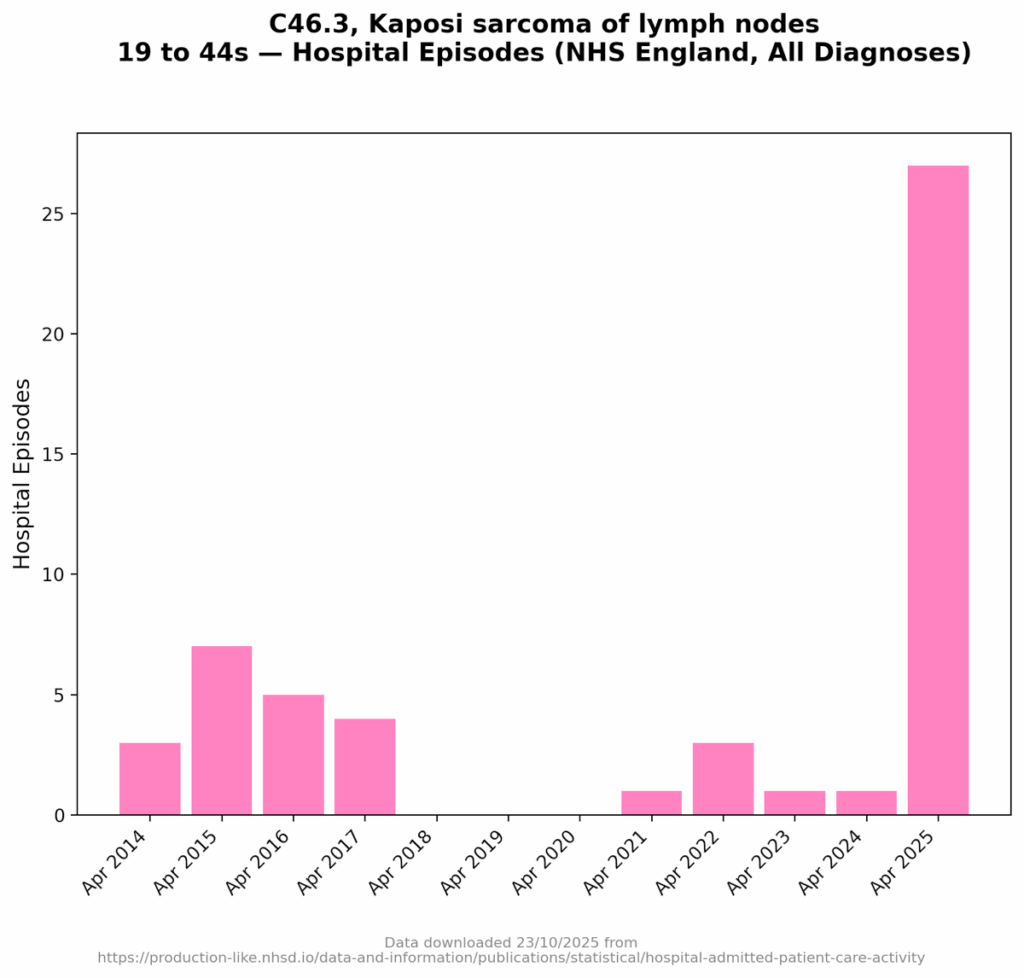
This X/Twitter thread (2025-10-25) shows a bunch of graphs of illnesses tied to impaired immune systems from the UK, and they are scary. I counted about 15 clearly distinct illnesses in 32 graphs. (There were, for example, a bunch of different types of tuberculosis; there were also some graphs split out by age group.)
The one that was scariest for me was the Kaposi’s Sarcoma graph — because I remember its close association with AIDS. Basically, young people didn’t get Kaposi’s Sarcoma unless their immune system was really messed up. Before AIDS, kind of nobody had ever heard of Kaposi’s Sarcoma. Now, there are a lot of Kaposi’s Sarcoma cases in England. Not good.
This paper from USA (2025-10-30) reports that among patients who had a certain type of surgery to remove a dense layer of fatty tissue (panniculectomy), patients with a history of COVID-19 were about twice as likely to have a vein blocked by a blood clot than people with no COVID-19 history.
This review paper (2025-10-29) reports that viruses are bad for your cardiovascular health. Multiple different viruses increase the risk of coronary heart disease, stroke, or myocardial infarction (AKA heart attack):
| Virus | Condition | Excess Risk |
| HIV | CHD | +60% |
| HIV | stroke | +45% |
| SARS-CoV-2 | CHD | +74% |
| SARS-CoV-2 | stroke | +69% |
| influenza | heart attack | +301% |
| influenza | stroke | +401% |
| hepatitis C | CHD | +27% |
| hepatitis C | stroke | +23% |
| shingles | CHD | +12% |
| shingles | stroke | +18% |
Vaccines
💉 This article from USA (2025-10-28) reports that last years’s vaccine provided 57% protection against hospitalization and death compared to people who did not get last year’s vaccine.
Treatments
🧀 This paper from Japan (2025-10-25) reports that people with COVID-19 who were treated with Lactococcus lactis — a bacterium used in cheese production — had only 12% of the risk of smell/taste loss as the placebo cohort. NB: Lactococcus lactis is one of the ingredients in the bog-standard Costco bottle of probiotics in my medicine cabinet. It’s not exotic.
Other Corona-viruses
Transmission
🦇 This preprint (2025-10-27) reports that scientists found an interesting new betacoronavirus (yes, the same family of virus as SARS, SARS2, and MERS) in a bat in Brazil. Two things of interest:
- The coronavirus looks different enough from all previously-known betacoronaviruses that it represents a new branch of the betacoronavirus family tree.
- It has a furin cleavage site in exactly the same place as the SARS-CoV-2 furin cleavage site.
The furin cleavage site makes it easier for SARS-CoV-2 virions to enter the cells, and was considered unusual enough that many people took the existence of the furin cleavage site to be prima face evidence that SARS-CoV-2 was created in a lab. The existence of a new bat coronavirus from a different branch of the betacoronavirus family tree makes that argument much less persuasive.
Can humans catch this virus? I don’t know, and I bet the scientists don’t know yet.
Measles
Transmission
😢 This article (2025-10-27) reports that Canada is likely to lose its certification of being a measles-free country.
According to the Government of Canada Measles and Rubella Monitoring Report (updated 2025-10-27), in the week ending 18 October, the following jurisdictions had the following number of cases:
- Canada: 19;
- Manitoba: 8;
- Ontario: 5;
- Alberta: 5;
- BC: 1.